TEVI: Text-Conditioned Editing of Visual Representations via Sparse Autoencoders for Improved Vision-Language Alignment
Findings of the Conference on Empirical Methods in Natural Language Processing (EMNLP) 2026
TL;DR
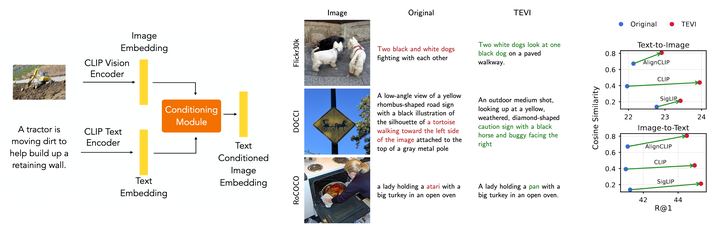
TEVI is a framework that uses captions to guide the editing of image embeddings via sparse autoencoders, improving vision-language alignment and retrieval performance.
Video
Hosted by YouTube. Pressing play loads the video from Google, subject to their privacy policy.
Abstract
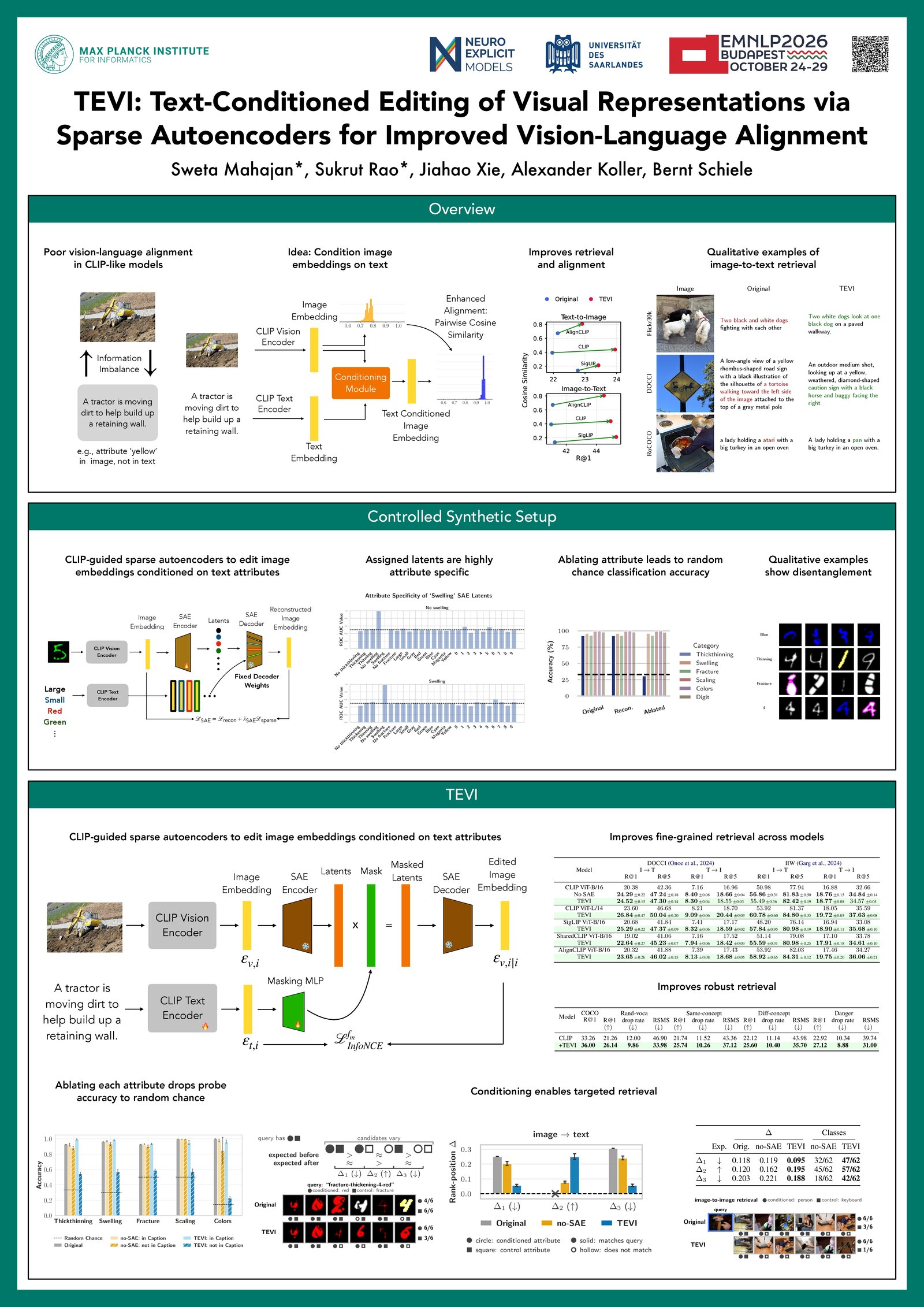
Vision-language models such as CLIP are highly useful for diverse tasks due to their shared image-text embedding space. Despite this, the image and text embeddings are often poorly aligned, affecting downstream performance. Recent work has shown that this can be attributed to an information imbalance: images contain more information than their captions describe. In this work, we propose TEVI, a framework that uses captions as a signal for what to retain from image embeddings. Specifically, we use sparse autoencoders to disentangle image embeddings and train a masking module to selectively reconstruct the embedding based on a given caption. In a controlled setup with synthetic captions, we show that TEVI is effective at preserving caption-described attributes while discarding others. By applying TEVI to CLIP models trained on natural images, we further achieve improved retrieval performance across coarse-grained short-caption (MS COCO, Flickr) and fine-grained long-caption (IIW, DOCCI) benchmarks, with stronger gains on richer captions, and improved robustness on the RoCOCO benchmark.
Poster
Slides