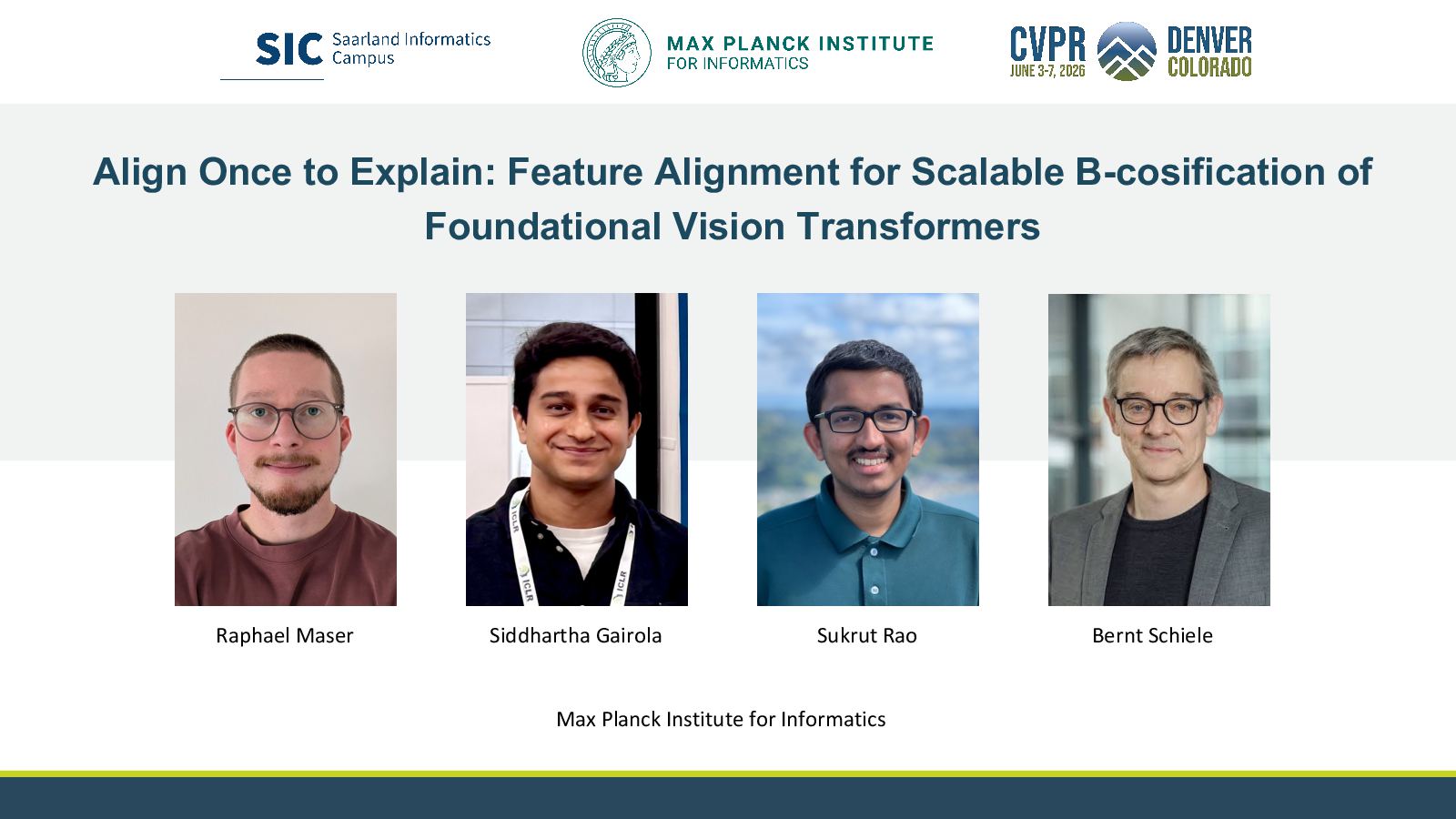
Align Once to Explain: Feature Alignment for Scalable B-cosification of Foundational Vision Transformers
IEEE/CVF Conference on Computer Vision and Pattern Recognition (CVPR) 2026
TL;DR
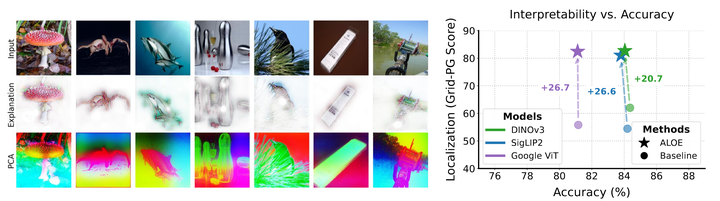
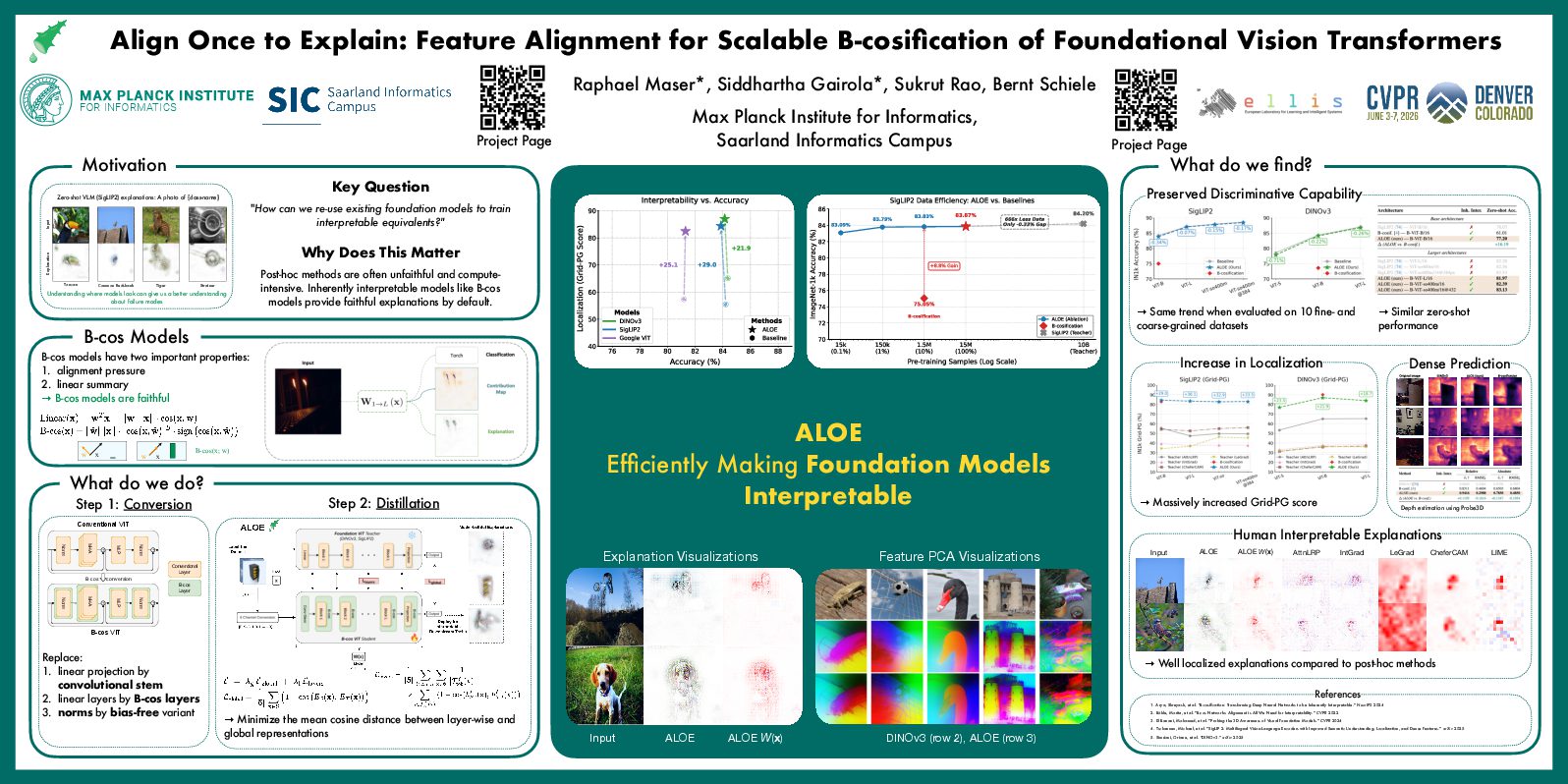
ALOE is a method to transform large-scale ViT-based foundation models such as DINOv3 and SigLIP2 into inherently interpretable B-cos variants at a fraction of the cost of training from scratch, bringing interpretability while retaining strong performance across a range of downstream tasks and datasets.
Video
Hosted by YouTube. Pressing play loads the video from Google, subject to their privacy policy.
Abstract
Foundational vision models have become the de facto standard for many vision tasks due to their strong performance. However, they are notoriously opaque and remain hard to interpret. We present ALOE (ALign Once to Explain), a one-time, label-free feature alignment approach that efficiently converts foundational vision models into inherently interpretable B-cos variants. Once aligned, the B-cos backbone is used as a drop-in replacement across several downstream tasks—amortizing the cost of interpretability. ALOE is robust across pre-training paradigms (supervised, self-supervised, vision–language) and is 100–1000x more data-efficient than training from scratch. On classification, it strongly outperforms vanilla B-cosification (e.g., +9.2 p.p. top-1 on ImageNet for supervised ViT-B/16), retains strong linear probing, k-NN, and zero-shot transfer competitive with foundational backbones (DINOv3, SigLIP2) across diverse downstream datasets. It also preserves spatially structured features useful for dense prediction, while yielding well-localized and highly human-interpretable explanations by design.
Poster
Slides